



TABLE OF CONTENTS
How to maintain team alignment and momentum when priorities shift, without breaking trust or burning people out.
Introduction
Tuesday afternoon. The sprint board displayed confidence, epics marching toward delivery, teams moving in rhythm, and QA showing green across the board. Then came the call: new business priority, same deadline.
It wasn’t a crisis. It was something more or less familiar, the quiet, decisive moment when yesterday’s plan stops being tomorrow’s answer.
If you lead long enough in technology, you discover that change isn’t an interruption to the work. It is the work. The details shift some times: a compliance window closes faster, a partner opens a better route, customer feedback reveals a sharper use case. But the feeling remains constant, the recognition that the map you were following just got redrawn.
This article draws on insights and real experiences from our Software Architects and Project Managers at Klika Tech, the professionals at the front lines of priority changes who navigate these challenges when they occur with their teams. Their testimonies have shaped the practical strategies discussed here.
The New Reality: Change as the Constant
At Klika Tech, like any other tech company, we often witness this pattern. Our projects span embedded systems, cloud infrastructure, and edge computing, each shaped by external forces that don’t check our calendar first: partner timelines, evolving client priorities, regulatory changes, and market feedback loops.
Vitaly, Software Architect: “Our priorities change quite frequently. We manage a large codebase, extensive infrastructure, and a wide range of clients while operating with limited resources. Because of our team size, adjusting priorities is one of the few levers we can use to remain effective.”
Change isn’t a planning failure. It’s the natural rhythm of complex ecosystems. What separates resilient teams from struggling ones isn’t avoiding turbulence; it’s how they navigate through it without sacrificing morale or momentum.
I used to believe the most important thing a manager could provide during transitions was answers. Experience has taught me differently. The most valuable contribution is clarity, not omniscience, not false certainty, but honest transparency about what’s changing, what’s stable, and what it means for the people doing the work.
Clarity Over Certainty: The Framework That Changes Everything
Years ago, I would wait to communicate until I had the “complete picture.” It felt responsible. It actually created an information vacuum that people filled with anxiety.
My approach now: “Here’s what we know. Here’s what we’re validating. Here’s when we’ll have confirmation.” This framework has stabilized more teams than any perfectly polished roadmap I’ve ever produced.
Sergey, Software Architect: “The fastest adaptation happens when acceptance criteria are crystal clear, understanding what should work and what we expect not to work. Then people can make local decisions on how to do things, compared to an ‘everything must be perfect’ requirement that creates constant fear of failing.”
When acceptance criteria are specific, teams can act locally without waiting for centralized approval on every decision. This autonomy accelerates adaptation dramatically.
The Practical Power of Early Transparency
Early communication delivers tangible benefits: it surfaces critical insights sooner. Twice this year, a “we’re considering this direction” notification revealed a dependency we would have discovered weeks later, in production. Because the information was transparent, the right person spotted it early and prevented a significant blocker.
Yuliya, Project Manager: “Our Software Architect and QAs are good at analysis and risk management. They often highlight complications and raise concerns, suggest other solutions or ideas that lead the project into ‘calm’ development and delivery, but not extinguishing fires.”
This kind of proactive risk identification only happens when communication channels are open and people feel empowered to raise concerns early.
This is where structure supports empathy. Objectives and Key Results (OKRs) help filter shifting requests through measurable outcomes. If a new priority doesn’t strengthen an existing objective, you re-evaluate rather than react reflexively. Decision-making frameworks like DACI (Driver, Approver, Contributor, Informed) clarify who owns which decisions, enabling informed pivots without organizational paralysis.
Sergey: “Knowing the release schedule, even as a rough point in time, helped form an ‘expected’ timeline. When priorities changed, we knew where we should return and what would be required, so we could re-estimate and re-align expectations.”
Four Principles for Navigating Constant Change
1. Expect change, but don’t normalize chaos
Teams embrace adaptation when boundaries remain clear. Constant change with unclear guardrails creates fatigue; purposeful adaptation with visible structure builds resilience.
2. Make trade-offs visible
Every new request displaces existing work. Name what you’re setting aside. This preserves trust and helps teams understand priorities beyond surface-level directives.
3. Communicate early, even when incomplete
Ambiguity managed collectively builds confidence faster than silence. Partial information with context beats complete information delivered too late.
4. Protect time for reflection
Every pivot contains signals worth capturing. Structured reflection transforms volatile experiences into institutional knowledge.
Building Technical Infrastructure for Flexibility
Beyond leadership practices, technical architecture plays a crucial role in enabling teams to pivot smoothly. Our architects have identified several strategies that reduce the friction of constant reprioritization:
Vitaly: “Over the years, shifting priorities has become a standard part of our workflow, and we have learned how to work with this dynamic. One key improvement has been optimizing our release process so that we can switch context more quickly and work independently of specific priority changes.”
Three Technical Enablers of Agility
Automated Release Processes: In the past, changing priorities required significant manual work to remove or adjust features in a release. Today, automated release flows support parallel development of multiple major features for different clients, with the ability to reassign resources as needed.
Feature Flags for Psychological Safety: When a task gets deprioritized, teams can still release the code by hiding it behind a feature flag. The code reaches production, but users don’t see it. This approach preserves team morale, and work isn’t lost or abandoned in old branches. Teams can easily return and enable features when priorities shift back.
Smaller, Independent Release Units: Breaking releases into smaller pieces (backend and frontend separately, for example) allows teams to deliver finished components quickly without extensive manual testing cycles. This creates visible progress even during turbulent priority changes.
The Emotional Foundation of Operational Alignment
You can track velocity, lead time, and defect rates, all valuable metrics. But there’s an invisible measure you sense after a significant pivot: Does the team still want to commit?
This shows up in stand-up updates that are concise but energized. In pull requests that demonstrate sharper thinking. In the shift from “What changed now?” to “What’s the next most valuable thing?”
One of the most challenging aspects of priority shifts is the accumulation of unfinished work. When tasks are left half-complete and revisited months later, the cognitive cost of context-switching becomes significant. This is why technical strategies like feature flags and automated releases aren’t just process improvements; they’re morale investments.
Understanding why priorities shift helps teams maintain motivation during transitions:
Yuliya: “Explaining the ‘Why’ we do the shift, the value of the feature or release, and what’s its importance helps maintain team motivation during sudden priority changes.
When people understand the business rationale behind decisions, they’re more likely to stay engaged even when the direction changes.
Building Reset Moments Into Transitions
We’ve learned to architect small “reset opportunities” into significant changes:
- Weekly architectural and cross-team syncs: Regular sessions where teams align on architecture decisions and trade-offs, ensuring everyone understands the bigger picture beyond their immediate tasks
- Targeted one-on-ones: Conversations asking not just “What’s blocked?” but “What aspect of this change concerns you?”
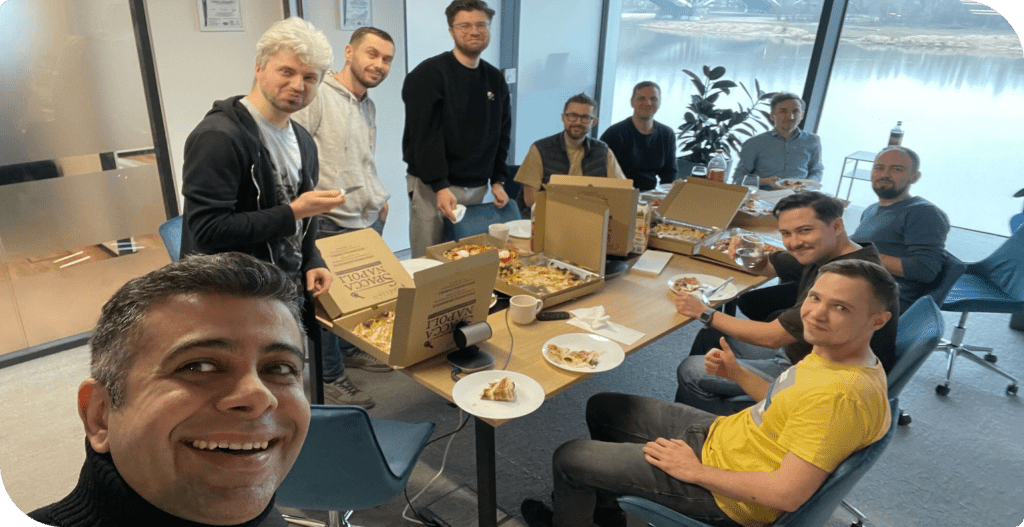
- Face-to-face reconnection: Monthly gatherings in the disguise of pizza days, bringing distributed teams together for collaborative work and human connection
Yuliya: “As a PM, I always have one-on-one calls to listen to each team member, understand how they are, and what concerns they have. I may assign less prioritized tasks to a teammate in case I feel or get information directly about the person having a tough time, being stressed, or having private issues affecting performance for a while.”
This human-centered approach recognizes that people can’t perform optimally when overwhelmed, and that flexibility in task assignment can preserve both productivity and well-being.
These aren’t “soft” activities. They’re operational infrastructure that unblocks invisible bottlenecks.
Ownership as Your Competitive Advantage
Here’s a predictable organizational response when priorities shift: leaders tighten control. They increase oversight to “minimize risk,” and suddenly, work flows like a parade, orderly, slow, single-file.
Ownership accelerates adaptation. When professionals own outcomes rather than executing task lists, they adapt faster and more intelligently. Liz Wiseman’s research on Multipliers demonstrates that leaders who delegate genuine ownership access nearly twice their teams’ collective intelligence compared to directive-driven management.
Yuliya: “Due to my approach of no micromanagement and the team’s skill level, all teammates work autonomously. We have Tech design calls where we discuss how we’re going to implement, test features, fix bugs, and improve our application. The whole team takes part in the discussion and knows the future changes. With micromanagement, it would be difficult to raise such a level of responsibility.”

The connection between autonomy and accountability is clear: when teams participate in design decisions, they naturally develop stronger ownership of outcomes.
Vitaly: “We often work with incomplete or loosely defined requirements. However, there is also a positive side. These conditions encourage the team to take more ownership of defining requirements and making decisions independently. Working with limited information helps our developers grow, as they need to operate autonomously and rely on their own judgment.”
Real Examples of Autonomy Driving Growth
Earlier this year, we needed to redesign part of the messaging architecture between our edge controller and cloud services under a new constraint. We could have prescribed the technical solution from leadership. Instead, we presented the problem to those closest to the implementation.
Within two days, an embedded engineer and backend lead proposed a hybrid design that solved the constraint while simplifying our failure recovery mechanisms.
Another example comes from our production systems. Due to limited resources and priority shifts, one of our developers gained a deep understanding of the system and was able to build significant components independently, without constant architectural oversight. The autonomy he was given in system implementation allowed the system to run reliably in production, and during this time, he grew significantly as a specialist.
Similarly, team members have demonstrated that working with limited information, when combined with genuine ownership, fosters accelerated skill development and professional growth.
Ownership isn’t leadership’s absence; it’s leadership’s investment in team intelligence.
Psychological Safety: Making Honesty Affordable
During a challenging sprint last year, a QA lead made an observation that saved us a full week: “If we address the visible regression now, we’ll overlook the fragile integration beneath it. We’ll face the same issue next week.”
It wasn’t popular in the moment. Because it was safe to voice, we heard it and adjusted. Safety reduced the cost of honesty; honesty improved our change response.
I model this by articulating uncomfortable truths: “We missed this signal.” “We overestimated our capacity.” “We can deliver this, but we’ll trade off resilience.” The more we demonstrate transparency, the more space team members feel to surface genuine concerns.
Truth becomes cheaper when leadership pays for it first.
The Multiplying Effect of Composure
I cannot quantify the value of a leader who maintains composure when timelines compress, but I observe its impact clearly. Panic propagates rapidly. So does steadiness.
During our most difficult deployment night this year, the solution wasn’t heroic individual effort. It was a twenty-minute break, role restructuring, and a simple statement: “We’ll execute the next right action.” We returned, and the next right action became obvious.
I once believed my role was radiating certainty. Now I focus on radiating composure. During transitions, teams don’t primarily want promises that nothing will fail. They want evidence that when challenges arise, we maintain cohesion.
Treating Pivots as Data, Not Drama
One practice has reduced organizational chaos more than any tool upgrade: treating pivots as learning opportunities. After each significant change, we conduct a brief “post-change reflection” with two questions:
- What early signal did we miss?
- What signal did we catch early, and how do we amplify that detection next time?
This generated our “change canvas” framework. It revealed which stakeholders to include earlier. It eliminated the pattern of surprising QA teams with architectural decisions that appeared “backend-only” but materialized as late-stage stability issues.
Sergey: “The worst experience is when multiple types of priority shifts happen simultaneously, people shifting between releases while new urgent work emerges. Each type requires different approaches because the causes are different.”
Understanding the type of priority change helps teams respond more effectively. People-based shifts (resource reallocation) require different management than release-based shifts (scope changes). Recognizing this distinction prevents one-size-fits-all responses that often miss the mark.
When you transform change into a learning system, it becomes less disruptive. The frequency doesn’t decrease; the turbulence does.
Stories: Theory Meets Reality
The Hidden Cost of Control
We once managed a release where every incremental change required management approval before teams could proceed. It preserved control but came at a cost: two talented engineers experienced burnout in slow motion.
Since then, we’ve restructured oversight. Instead of approving every step, we align on outcomes, defining what “successfully completed” means, and review at milestones. Morale recovered. Execution velocity improved.
The Value of Early, Incomplete Information
We knew a client’s priorities would likely shift, but kept it confidential “until confirmed.” When the change materialized, the team responded as if I’d withheld critical warnings. I had, with protective intentions.
We debriefed and decided to prioritize early, partial information. A month later, when a similar change emerged, the response differed: “Thanks for last week’s notice. We’ve mapped the two highest-risk dependencies. Here’s our primary and backup plan.”
Identical turbulence. Fundamentally different experience.
Not Every Change Requires Immediate Action
Yuliya: “Not all changes are to be done ASAP and yesterday. Don’t panic. Ask why it’s important to do and then analyze. It might happen that this change is not needed at all.”
This wisdom is critical: the discipline to pause and evaluate whether a requested change truly serves strategic objectives can prevent unnecessary disruption and preserve team focus on high-value work.
Simple Mechanics, Difficult Discipline
The underlying mechanics are straightforward: document what’s changing and why. Communicate early. Define outcomes, not methods. Create safety for honest feedback. Capture lessons systematically. Build technical infrastructure that supports flexibility.
The difficulty isn’t the process, it’s maintaining discipline when pressure intensifies. When priorities shift, alignment doesn’t emerge from louder directives. It comes from quieter confidence, from leaders willing to state: “We cannot accomplish everything, so this is what we will do, and here’s why.”
During uncertainty, ownership isn’t merely a cultural preference. It’s an operational advantage. Successful organizations coordinate without constraining, move without fragmenting, and receive truth fast enough to convert it into direction.
Moving Forward
The work doesn’t become cleaner. Priorities won’t stop shifting. Partners will continue to surprise you. Markets will keep moving.
But if you build clarity instead of false certainty, delegate ownership instead of instructions, create psychological safety instead of rigid control, invest in technical infrastructure for flexibility, and treat every change as data instead of drama, your team won’t merely survive the next pivot.
They’ll accelerate through it.

Key Takeaways for Leaders
- Lead with transparency, not certainty – Partial information with context beats delayed complete information
- Make trade-offs explicit – Visibility preserves trust during transitions
- Delegate outcomes, not tasks – Ownership unlocks team intelligence at scale
- Invest in technical flexibility – Automation, feature flags, and modular releases reduce pivot friction
- Create psychological safety – Honest feedback becomes your competitive advantage
- Systematize learning from change – Each pivot is a data point for improvement
- Model composure under pressure – Your emotional state multiplies across the team
Further Reading
- Chrissy Scivicque, How to Manage Constantly Shifting Priorities, Eat Your Career (2023)
- Liz Wiseman, Multipliers: How the Best Leaders Make Everyone Smarter, HarperCollins (2017)
- Are You an Accidental Diminisher?, Harvard Business Review
- Project Management Institute (PMI), Managing Priorities Effectively
- Klika Tech blog post: The Leadership Multiplier – Creating a Culture of Ownership Without Micromanagement
By, Mohammad Shirazi, Portfolio Manager, Klika Tech